Rows, Semicircle or Loose Clusters: Seating for Different Rooms
Seating arrangements for community film screenings shape sightlines and shared attention. Choose rows, a semicircle or loose clusters to suit your room.
Where should the chairs go so everyone can see the film without making the room feel like a lecture hall? For community film screenings, seating arrangements change both the view of the screen and the sense of watching together. Rows, a semicircle and loose clusters each suit a different room shape, audience and evening. The useful choice is the one that keeps the picture visible while making arrival and settling in feel natural.
Think of the seating plan as a decision made in stages, not a furniture puzzle to solve at the last minute. Start with the room as it is, then consider where the screen sits, where people enter and how much conversation you want before and after the film. A handful of existing chairs can make a close, welcoming screening; a larger supply can still feel awkward if the layout leaves people craning around one another.
Begin with the room’s fixed features
Before shifting chairs, stand where the audience will sit and look at the screen position. Note doors, pillars, radiators, windows, low beams and any wall fittings that cannot move. A column in the middle of the room may split a neat row arrangement in two. A door behind the screen area might make a semicircle impractical if late arrivals have to cross in front of viewers.
Also look at the screen from the edges, not only from the centre. If the image is projected onto a wall, its usable area may be limited by a window frame or a bright patch of paint. A television or freestanding screen may have a narrower comfortable viewing angle than a large, flat wall. Check the maker’s instructions for display positioning where they apply; local requirements and the room’s own arrangements also take precedence.
Give the route from the entrance to the seats a clear, obvious shape. People arriving with coats, bags or a cup in hand need room to find a place without threading through someone’s view. Do not treat a convenient gap as a safe route if it is blocked by furniture or equipment. For questions involving access or safety rules, ask the venue’s responsible person rather than improvising.
Rows make the screen the shared focus
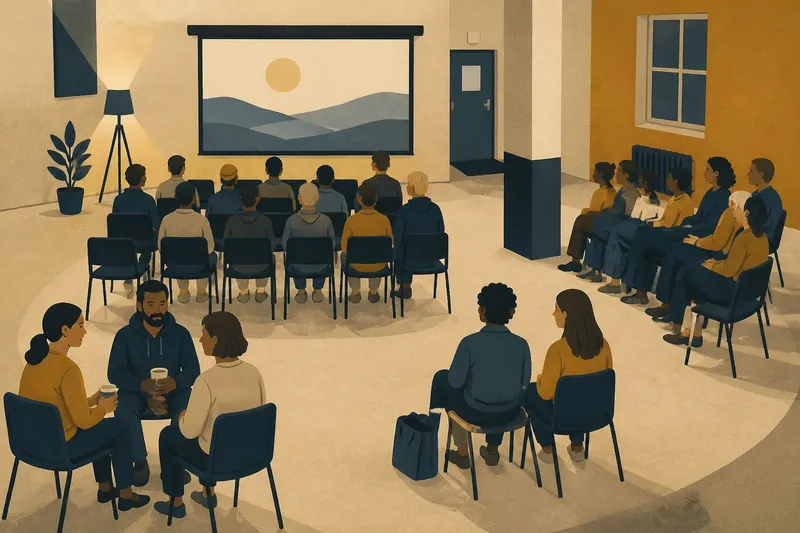
Rows suit a long, narrow room, a large audience or a film that benefits from sustained attention. They point everyone towards the same image and make it straightforward to see where the front is. The arrangement can feel focused without extra furniture or decoration, especially when the chairs are already similar and easy to move.
There is a trade-off: a row can give people in the back a view of shoulders rather than the screen. Stagger each row so chairs sit in the gaps ahead, instead of lining up directly behind one another. If the room allows, leave a modest offset between the front and rear seats; it can help sightlines without pushing the last row against a wall. Do not create a narrow passage that people have to squeeze through.
Rows are also the simplest arrangement to adjust when attendance is uncertain. You can leave a few chairs at the rear or sides and bring them forward if needed, rather than filling the room with furniture from the start. Keep any spare chairs out of the viewing line and out of the entrance route. An empty seat is less distracting than a pile of chairs beside the screen.
This layout has the most formal feel of the three. That can be useful for a quiet screening or a room where the audience needs a clear common direction. If the gathering is meant to feel more conversational, rows need not be perfectly straight or rigid: a slight curve can soften the effect while keeping the screen dominant.
A semicircle can bring the audience together
A semicircle works well when the room is broad enough for people to sit around a central viewing area without turning too far sideways. The front of the arc faces the screen; the ends curve gently towards it. This shape makes neighbouring faces easier to notice and can make a small gathering feel like a shared event rather than a line of separate viewers.
Its success depends on the angle. If chairs at the ends face too far away from the screen, viewers may twist in their seats through the film. Keep the arc shallow enough that everyone can face the picture comfortably, and avoid placing a chair so close to the screen that its occupant has to look sharply upwards. Try sitting in the end seats as well as the centre ones before people arrive.
A semicircle can leave an open area in the middle, which may be useful for a room with a central obstruction or for keeping the entrance side clear. But a big empty centre can make viewers feel distant from one another. Bring the arc closer together if the room permits, while leaving enough room to pass between seats. Avoid filling the middle with a table or display that blocks the view.
Say you have a village room with a screen on the short wall, a doorway at the back and a pillar near one side. You could test a shallow semicircle with the pillar outside the arc, then sit in the end chair to check whether the screen remains in view. If the doorway cuts across the open side of the shape, turn the arc so arrivals can reach seats without walking in front of the audience. The expected result is a connected arrangement with a clear route, not a perfect geometric curve.
Loose clusters suit flexible rooms
Loose clusters use small groups of chairs rather than one continuous formation. They suit informal rooms, irregular floor plans and audiences who may arrive in groups. A few pairs and small groups can make it easy to sit beside a friend, while leaving gaps between clusters for movement.
The screen still needs to be visible from every seat. Angle each cluster towards the same focal point instead of letting chairs face in several directions. A chair turned towards a friend may feel sociable before the film, then become uncomfortable when its occupant has to watch over a shoulder. The arrangement should allow conversation without asking anyone to choose between joining in and seeing the image.
Clusters can also make a room feel scattered if they sit too far apart. Keep the groups close enough to share the film’s attention, and avoid arranging chairs around tables that become visual barriers. If there are only a few chairs, two compact groups may work better than several tiny islands. Leave a clear route between the groups rather than filling every gap with another seat.
One useful distinction: clusters make social choice more visible. People can join a group or take a quieter seat at the edge. That flexibility is helpful when the audience includes people who do not know one another, but it can also make a small room feel divided. A subtle shared orientation towards the screen holds the room together without forcing every chair into a straight line.
Match the arrangement to the evening
Choose rows when direct sightlines and a clear shared focus matter most. Choose a semicircle when the room can support a gentle arc and you want people to feel aware of one another. Choose loose clusters when the room is informal, the floor plan is awkward or guests may prefer to settle in small groups. These are tendencies, not rules; the actual room and the people using it matter more than a label.
Before committing, ask three practical questions:
- Can every seat see the screen? Check the edges, rear seats and any chair behind a pillar.
- Can people reach a seat without crossing the picture? Look at the entrance and the route from it.
- Does the shape fit the mood? Consider whether the gathering calls for a focused audience, a shared circle of attention or informal groups.
- Can chairs be moved quietly? Avoid a layout that needs repeated rearranging once the film begins.
Do not spend time making every chair perfectly symmetrical. Straight lines and matching gaps can look tidy, but they are not worth sacrificing an unobstructed view or an easy route. Likewise, elaborate labels for each seating section are usually unnecessary for a small community screening; a clear entrance and a friendly welcome do more.
How do you check a seating plan?
How do you stop the back row from blocking the screen?
Stagger chairs so each person looks through a gap between the seats ahead. Then sit in the rear and check the screen edges, not just its centre.
Are semicircles comfortable for long films?
They can be, if the curve is shallow and end seats do not point sharply away from the screen. Test those seats before choosing the arrangement, since the angle matters more than the shape’s appearance.
Can loose clusters still feel like one audience?
Yes, if the chairs share a general direction and the clusters are not scattered across the room. Leave comfortable gaps for movement, but keep the groups visually connected to the screen.
What if the room is too small for the planned layout?
Remove chairs before people arrive rather than squeezing them into a blocked route or a poor sightline. A smaller arrangement that works is more welcoming than a crowded one that makes viewers turn or shuffle.
Make one final check before the audience arrives
Once the chairs are in place, walk in through the entrance as a guest would. Look for the first available seat, follow the route and sit in a few places around the room. If a chair blocks the screen, shift it; if a gap invites people to walk in front of viewers, adjust the route or the layout. A small change now can spare everyone a distracting shuffle later.
For community film screening seating arrangements, the best plan is not necessarily the most formal or the most sociable. It is the one that gives each person a comfortable view while letting the room feel like a place to watch together. Keep that balance in mind, and rows, a semicircle or loose clusters can all work with the chairs you already have.