A Quiet After-Film Conversation for a First Gathering
A quiet after-film conversation gives a first gathering gentle prompts, useful pauses and room to pass, so people can share a response without pressure.
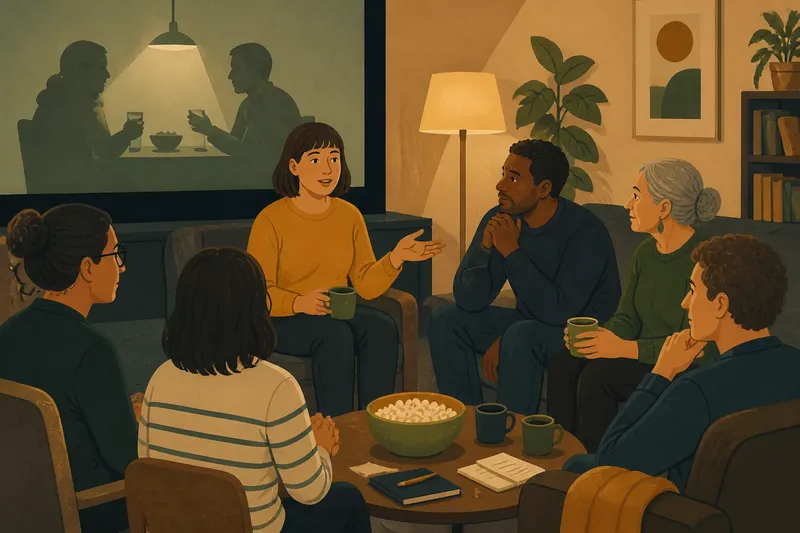
What do you say after the credits roll when nobody knows one another well enough to jump in? A quiet after-film conversation can begin with a little breathing room, one open question and the clear understanding that listening counts as taking part. The aim is not to extract a verdict from every person. It is to let the film linger in the room without turning the gathering into a seminar.
For a first screening, keep the host’s role modest: invite, listen, and make it easy to decline. A few thoughtful questions will carry more warmth than a long list, while pauses give people time to decide whether they want to speak. The sequence below works in a living room, community hall or library meeting room, and can be shortened if the group is ready to leave.
How should a host open the conversation?
Start by naming the choice people have. Try: “We’ll take a few minutes to talk about the film. You’re welcome to listen, speak, or pass; there’s no right answer.” Then leave a short pause before asking anything. This gives the invitation time to land instead of making it sound like a roll-call.
Keep the first question close to personal response rather than interpretation. “What moment is still with you?” lets someone mention a sound, a face, a line, a colour or a feeling. It does not demand that they explain the plot or produce a clever reading. If the room is quiet, allow the silence to remain for a little while. People may be gathering a thought, not waiting to be rescued.
As host, answer briefly if that helps break the ice, but do not deliver a speech about what the film means to you. A small, specific response shows the scale of contribution that is welcome. For instance: “I keep thinking about the scene at the bus stop; the room seemed to change after it.” Then return the space to the group.
Which open questions invite a genuine response?
Choose questions that have more than one possible answer and do not assume everyone liked the film. Start with observation, then move towards interpretation or connection only if the room seems ready. A compact sequence can be:
- “What moment is still with you?”
- “Was there a detail you noticed only after it had passed?”
- “Did anything in the film change how you understood a character or situation?”
- “What question, if any, are you leaving with?”
Ask one question at a time. Resist adding a second prompt when the first has not yet received a response; people can feel that they are being steered towards the host’s preferred answer. If a participant offers a short reply, treat it as complete. “Thank you” or “I can see why that stayed with you” acknowledges the contribution without asking them to defend it.
Say you are hosting a first gathering after a quiet, character-led film, and one guest mentions a tense dinner scene. You might ask, “What did you notice about how the family spoke to one another there?” If another person answers that the silences mattered more than the dialogue, the group has something specific to consider. The expected result is not agreement; it is a conversation rooted in a shared moment rather than a demand for a grand judgement.
How can a host use silence without making it awkward?
Leave a deliberate pause after each question and after each answer. A calm pause signals that nobody needs to race for the floor. It also helps separate one person’s thought from the next, so quieter contributions are not swallowed by a fast exchange.
Make the pause feel ordinary through your own manner. Look around the group without fixing your gaze on one person, keep your hands still, and avoid filling every gap with a new question. If the silence stretches and the group appears comfortable, it may be doing useful work. If people look uncertain, offer an easy route in: “You could name a scene, a sound, or simply say what mood you left with.”
Do not turn the pause into a test. Avoid scanning the room as if selecting someone who has failed to answer, and do not ask each person in turn for a reaction. A round can be useful when people request one, but imposed turns make passing feel conspicuous. Let the conversation be uneven; a thoughtful exchange need not give every voice the same amount of airtime.
What should the host do when opinions differ?
Make room for disagreement without asking anyone to win. If one guest calls a character selfish and another sees them as frightened, you can reflect the difference: “We’re reading that choice in two ways.” Then invite the group to consider what in the film led them there, rather than asking who is correct.
Keep discussion anchored in the work. Questions such as “Which moment gave you that impression?” help clarify a response without challenging the person’s right to have it. Avoid turning a disagreement into a debate about who watched more carefully. People can notice different details and leave with different reactions.
If a comment becomes personal or dismissive, intervene briefly and calmly. You might say, “Let’s talk about the character’s choice rather than judging someone here.” Then shift to a film-centred question or offer a pause. This keeps the gathering welcoming without requiring the host to settle every interpretation.
How can people take part without speaking?
Say plainly that listening is participation. Some guests may want to sit with the film, may need time to form a thought, or may simply prefer not to speak in a group. Do not ask them to explain a pass, and do not treat silence as a sign that the event has failed.
Offer a quiet alternative only if it suits the room. A small stack of blank cards and pencils can let someone jot down a scene or question for themselves, but there is no need to collect or read the cards aloud. A cup of tea, a clear path to the door and permission to leave when ready can also make the gathering feel less binding.
Say you have invited a handful of neighbours who have not met before, and one guest prefers to listen. You ask the opening question, leave space for replies, and do not direct a turn towards that person. They can remain part of the circle without being put on display; if they later choose to contribute, the invitation is still open.
How long should the conversation last?
Let the group’s attention guide the timing rather than trying to fill a set stretch. A first gathering often benefits from a small number of questions and a clear ending. Tell people that you will close after one last prompt, then follow through instead of extending the discussion simply because there is more to say.
A useful final question is, “What are you taking away from the film tonight?” It can invite a thought, a feeling or a detail, but nobody needs to answer. After the pause, thank the group for sharing the room and make any practical next steps clear, such as where refreshments are or how to leave the venue.
It is not worth preparing a long list of prompts, printing a formal discussion sheet for a relaxed first meeting, or trying to turn every answer into a deeper exchange. Too much structure can make a shared viewing feel like a class. Keep a few spare questions in mind, and use them only when they genuinely help the conversation move.
What if nobody answers the first question?
Should I repeat the question?
Wait first, then repeat it once in simpler words if the room seems unsure. You can also offer a few routes into an answer, such as a scene, sound or character, without calling on anyone.
Should I answer first?
A brief response from the host can show that a small observation is enough. Keep it specific and short, then leave the floor open rather than explaining what everyone else ought to notice.
Can I move on if the silence continues?
Yes. Thank the group for sitting with the question and offer another one, or close the conversation if people seem ready to go. A quiet ending is still a valid ending.
How can the host close without summing up everyone else?
End by acknowledging the contributions without announcing a shared verdict. “Thank you for the different things you noticed” leaves room for disagreement and for thoughts that stayed private. Avoid summarising what the group supposedly learned; a host cannot speak for every person in the room.
For a quiet after-film conversation, the most useful preparation is modest: choose a few open questions, make passing an ordinary option, and leave pauses long enough for people to think. The host does not need to keep the room lively at every moment. A gentle close, followed by an unhurried chance to chat or head home, gives the film space to travel with people beyond the chairs.